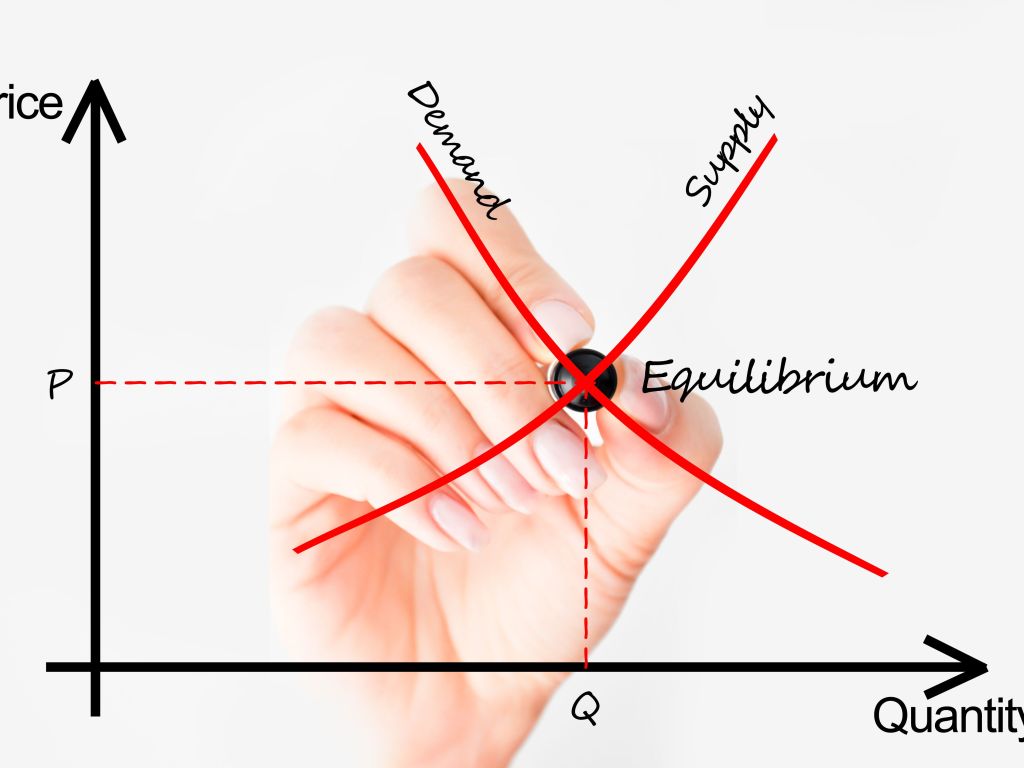
Now that we have a beautifully designed kitchen and the right equipment we are all set for producing great food. Wait, now we need to understand the critical third ingredient. Time for some Economics 101 – the theory of demand and supply and how it impacts the production of innovation (meaning great food) in our Kitchen!
The Demand Side

Economics 101 says that demand for a product is typically where it all begins. Here of course, we are talking about food and you may be wondering – I have a stomach so I am going to generate demand for food!. Yes, you are right in one sense. We need food for survival. But, a more relevant question is what kind of food do you demand? The answer then tends to be come more nuanced and we have to then go beyond the stomach to what gives us happiness.
Imagine for a moment that you are a customer of the food that is produced. Here are a few questions and your responses would determine what is produced in the kitchen.
1] What kind of food do the majority of the members want to eat?
On one end of the spectrum are customers who do not want to take any risks. You like sameness. You do not experiment. So a set pattern is what you like. For example : Breakfast means Idli or Dosa or Upma with Chutney and Sambar. For lunch it is rice with one liquid and two dry vegetables. For dinner may be Chapati and Curry. This is what you like and this is what you demand from the kitchen week after week.
One the other side imagine that you are a customer who loves to eat variety. You hate sameness. For example : Breakfast can be a smoothie one day, omelette the next day, Idli on the third day, cereals on the fourth, Sandwich on the fifth, pancakes on the sixth and Masala Dosa on the seventh and so one.
While the latter is demanding, it also puts pressure on the production system to become innovative and produce variety. Invariably, the first example stifles creativity in the Kitchen.
2] Do the customers give critical feedback?
One type of feedback from customers would sound like “Today, the food was good/bad”. A second feedback is a don’t care attitude. I just need some food to quite the growls from down under – quantity is the typical barometer here. But, these do not give clues to the Supply side on how to improve or innovate.
On the other hand, critical feedback would sound like “The sambar is bland, it could have benefited with a little bit more spice. That chutney is too acidic, may be addition of some sweetness would help. A cheese topping on this pasta would have enhanced the flavour. The Rasmalai had the perfect consistency and sweetness, the one that we eat in the restaurant is too sweet. The brownie had the perfect crust and softness.”
What critical feedback does is to be more specific with respect to the good and the areas for improvement. Imagine a Boss – Subordinate relationship in the office. Junior employees would always enjoy working with a Boss who is encouraging but the at the same time very specific with respect to both positive and negative feedback. This creates the right chemistry and the atmosphere for motivation.
3] Do customers bring new demands or ideas on the table?
What would be your reaction if you are a parent when your child comes and tells you that she tasted the most amazing pani poori at her friends place. She is emphatic that it is so much better than the one we get in Rangoli. Similarly, what happens to the production system when customers bring ideas to improve the product or suggest a new product. Eg: “Let us try a different version of the poha for breakfast – let us add some pomegranate seeds and bujiya for garnishing. Or the customer suggests a variation of a dish such as a Beetroot Risotto instead of the often cooked Mushroom one. Even better, if the customer brings in a recipe for a new dish altogether like a Moroccan Tagine.
Again, going back to the office example, this would be like employees making suggestions based on what they have learned about elsewhere for implementation (such as Six Thinking Hats in a meeting or Memos instead of Powerpoints or a new process quality check in manufacturing). Hope you get the drift.
4] How large is the pool of customers?
Entertaining guests at home may not be on everyone’s agenda. But this is a way to test the market beyond the home customer base of family members. But hold on. The driver for innovation would only be effective if you are willing to serve them a good percentage of home cooked goodies. Buying food from outside is an option. However, that does not work for innovation in the kitchen.
These experiments in broadening the customer base and continuous feedback becomes the adrenalin required for innovation in the Kitchen.
The Supply Side

Now let us turn our attention to the supply side. This is the Kitchen Kartha. It need not be one person alone, the more the number of Karthas the more merrier it becomes.
1] What is the Kartha’s propensity to learn new things?
Imagine an office where the employee is not inquisitive about what is happening in the industry but is only willing to do what he/she is instructed to do. A closed mindset and an unwillingness to learn would make Jack a dull boy. He/She will no longer be the favourite when it comes to promotions and bonuses. On the other hand, a subordinate with a learning mindset would get all the attention for the next new assignment and would soon emerge as a blue eyed girl.
Something similar happens in the kitchen with the Kartha. If the Kartha has the propensity to learn new things then it is logical to assume that this would lead to innovation in the Kitchen. This mindset to learn would lead to understanding why some ingredients are added and why others are not? or What flavour combinations work with each other?
2] How much time does the Kartha have to invest?
A learning mindset alone is not enough. Karthas manage multiple priorities. What is the pecking order of priority for things to do in the Kitchen; whether it is about new dishes, equipment or Science. If a decent amount of time is not allotted, then the chances of something new coming out of the kitchen is remote.
You would have heard of the Company 3M (Post it, Scotch Brite!). In this Company 20% of the time of all employees is set aside for thinking about the future. No wonder 3M has been continuously ranked as one of the most innovative Companies in the world.
3] What is the Kartha’s risk score?
Cooking like many things in life is a combination of Art, Craft and Science. [More about this in one of the later blogs]. Without a decent amount of investment in at least two of them, there is little chance of success. The most important in my view is the Craft part of it. This means a willingness to take risk and experiment and learn from the mistakes. Keep repeating till the repeatabilty score reaches 80% and above.
Two qualities would work in your favour. One is courage to experiment. The second is to learn from failure.
4] What is driving the Kartha?
Why is the Kartha in the kitchen? What is the larger purpose? Is cooking a chore, a hobby or a means to serve others? What makes you glow with joy? What is your source of inspiration?
Each of us as a Kartha would have different answers to the above questions. My own take is if you think it is a chore then do not be surprised at the lack of innovation or variety that is produced. The higher you are on the scale of pleasing others (“I want to see a smile on others face rather than a full stomach – although both is a great goal!”), you improve the chances of great things being produced in the Kitchen.
So ladies and gentlemen, hopefully I have been able to establish that the right mix of demand and supply factors has the best chance of producing great food in your Kitchen. This is the icing on the cake, beyond of course, a decent place to work and one which is well equipped!
 Anubhavarasa