As you grow older you earn for company. As my wife says, better to travel as a group rather than as a couple! We found the perfect pair and location when my friend suggested that we go to Dudhwa. Eh! Never heard of this place. He said “Guaranteed tiger sighting!”. My adrenalin and enthusiasm went up. I said YES even without glancing at my wife!
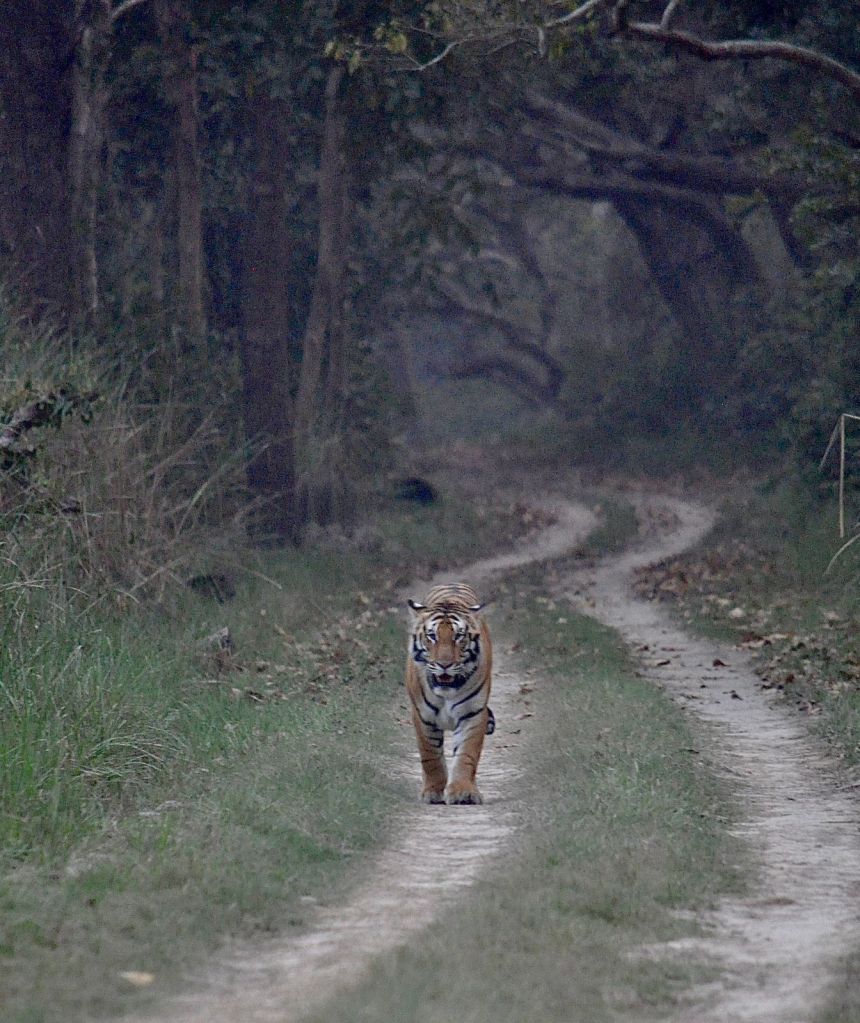
Getting There : It is a good four to five hours from Lucknow with no good places to stop over on the way. We managed a stop at Brahmadeep restuarant, with decent washrooms and serving Kullad Chai. No Dosa’s though! [A set of guests did enquire about Dosa when we were there and promptly walked out when the waiter said we serve only paratha’s and biriyani].
On the way, I observed a couple of interesting sights. One was related to an advertisement for study classes for IELTS, as a pre cursor for seeking admission to Universities in the UK, Canada, Australia, New Zealand. My mind raced to draw some conclusions. Rural India and rural UP is not bad. The next generation is aspiring to study and go abroad. Has UP really changed in the last few years? As these thoughts were crossing my mind, I made a second observation. We spotted a number of gurudwaras welcoming guests for langar. Are we in Punjab by mistake? We did land in Lucknow and after breakfast left Lucknow by road. Surely, Punjab is not four, five hours by road even if we are on the world’s best expressway! And then I made my third observation. Large cultivation of sugarcane and wheat became visible. Sugarcane seems to be the most prominent with at least two mills (Balrampur Chini and Bajaj Hindustan) welcoming large tractor trailers loaded with cane. (It seems that the water table is only 20 feet as this area which is called Terai – meaning flood plain. Logical for water intensive crops which do not require healthy soil?). Only later did I connect all the three observations.
The Sikhs of Terai : The history can be linked to partition, when Sikhs from West Punjab migrated to India in large numbers and had to be provided a dwelling. Each family was allocated 12 acres of land in the Terai (considered a difficult region for agriculture where the local population was not making any headway), provided they had already been in farming. As per the 2011 census, there are about 100,000 Sikhs in the Lakhimpur Kheri district (constituting about 3% of the population). If you are interested in how this place became a mini Punjab see articles [1] and [2] in the notes below. The observations above now got connected on a straight line !
Stay at Dudhwa : We stayed at a premier property which is part of a national hotel chain. Standards of upkeep were excellent including hygiene as well as customer care. The team consists of the General Manager who doubles up as the tour guide for the Safari, an excellent house keeping staff and a hospitality and kitchen crew. Curated menus, a bar by the pool was a bonus. The litchi and mango trees surrounding the property added to the warmth while keeping the atmosphere cool!
Conversation at the resort with the owner ranged from history of the place, the advantages of tying up with a well known brand (savings in marketing costs), finding and training the staff with some good social impact and humanitarian policies (local employment, three months holiday when the park is shutdown at 50% pay which gets paid over the succeeding three months), finding good chefs who specialise in more than one cuisine, the ambitions of children and whether to let them explore or join the family business, keeping the resort open for both guests and wildlife (unfenced), farming with advanced technology and working with local people for farm produce marketing. The host and his wife were charming and down to earth and there is a lot to take away for any anyone in the hospitality business.
Spotting Tigers : There are four tiger reserves in the immediate vicinity of Dudhwa. These are Philbit Tiger Reserve, Katarniaghat Wildlife Santuary, Dudhwa National Park and Kishanpur Wildlife Sanctuary. We ended up visiting Dudhwa and Kishanpur. More on all the tiger reserves in the whole of India Nepal belt in article [3] below. According to the big cat survey [4], tiger population in Dudhwa is 135.
The race to see the tigers starts at 5 AM in an open Gypsy or Mahindra Jeep. You should be at the gate with an appropriate pass at 545 AM. A guide jumps in and promptly occupies the front seat next to the driver with passengers in the back. Once inside it is a cat and mouse game! The guide starts at a place where he saw one last evening, then looks for pug marks, poop, uses his sharp hearing to decipher the calls (See note [5] below) and then races away to where he thinks the spotting probability is more. If you are in the rear of the vehicle and are not harnessed, these 180 degree turns and the sharp acceleration of the vehicle can throw you off balance and you may lose your bearing in the process. That is part of the thrill! But, this alone does not guarantee a sighting. You need to get to the spot before other jeeps so that you can be closer to the tiger than be far behind (Imagine watching a cricket match from row Z vs row A!). The guides and drivers do cooperate though since their incentive in terms of tips and future income comes from the success that every tourist carries back (Social media to blame!).
Do not be disappointed if you do not spot one in the morning. There is another in the afternoon and again the next day (except when the park is shut for the weekly off which is a Tuesday). All it requires is lots of patience, energy and perseverance. Did we succeed? Some of us did more than others, some were lucky to be in row A while others were in row Z. And we hope to come back for another round of adventure, another time!
Role of local Government and Regulation : Should UP Tourism do more to promote these sanctuaries. Absolutely yes. Compared to the parks in MP, the infrastructure is very poor. We could do with more clean toilets, rest places for breakfast or meals, a little bit more marketing and a more evolved system for tourist management ( A token system which is online, increasing the number of jeeps into the Rhino area which is presently restricted to four etc)
Billy Arjan Singh : Billy is spoken as the father of conservation in India and also responsible for setting up the Dudhwa National Park. He was apparently a hunter, turned conservationist. At the resort, we had the privilege of watching a video of his love for the big cat, how he reared a cub to an adult tiger and the enduring bond between him and the animal (so much so that when they play together the cat retracts it claws not to hurt Billy). Read more about him in Note [6].
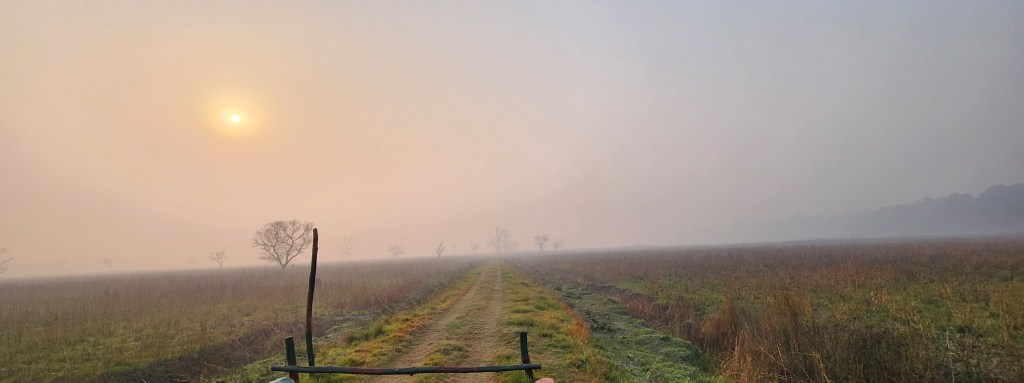
Man/Animal Conflict : In contrast to the enduring love story between Billy and the big Cat, the entire Terai is a potential conflict zone between man and animal. We have burned down forests to convert more land into agriculture. A tigress considers overgrown sugarcane farms as a good place to rear the cubs away from predators. Imagine her surprise when a human discovers her and her cubs in the field leading to an unplanned outcome! This is not specific to Dudhwa alone. See articles [7] and [8] in the notes. It is difficult to draw boundaries for the animal, when we as intelligent humans are found wanting in drawing boundaries ourselves!
In conclusion, this travel took us to a part of India we have not seen before. Each such travel enlightens us to the diversity of India and opens our eyes to the fact that we are clearly more than a sum of our parts. A micro region has its own history to tell, environmental challenges, with humans trying to get better than the previous generation. How can we do this without creating disparities and without damaging the bio diversity and cultural diversity will be the most important challenge for our country and its citizens.
Notes
[1] https://www.baaznews.org/p/lakhimpur-kheri-mini-punjab
[3] https://www.tigersafariindia.com/blog/terai-arc-landscape-tigers-of-rajaji-corbett-dudhwa-pilibhit/
[4] https://bigcatsindia.com/tiger-census-2022/
[6] https://en.wikipedia.org/wiki/Billy_Arjan_Singh
[7] https://www.teriin.org/sites/default/files/2020-02/meeting-challenges-humanpf.pdf
 Anubhavarasa