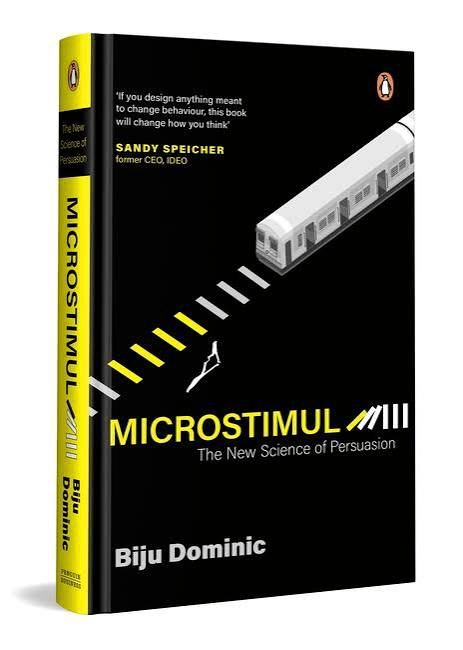
We have a book club, as part of our Coaching community. It is called the REGAL BOOK CLUB. I am part of the core committee that selects books. I also enable discussions around our book of choice. The book that we are reading this month (Oct 2026) is called MICRO STIMULI by Biju DOMINIC. Earlier this week a debate centred around the following questions:
[1] What is subconscious? What is conscious part of the brain?
[2] Is consciousness different from awareness or being present?
[3] If most of the work that the Brain does is in the subconscious, and the purported reason for this is to save energy, how are Yogis able to be aware and survive on minimal food and sleep?
[4] Is the author using a western philosophy to butter his arguments?
[5] Being present is one of the most important skills for a leader. If the leaders actions are primarily driven by the subconscious, how can the leader be effective?
These questions were posed by one participant and most of the time was devoted to this with no concrete ideas emerging. This post is an attempt to bring some clarity.
First, my assumption is that the participant has not read the book and entered a discussion without understanding the context of the book. So let us set that right. Fundamentally, the book emerged from two decades of practice in trying to understand human behaviour and create interventions based on this understanding. One critical way in which the human brain functions is by creating routines based on past experience. Imagine how a learner of a car drives and how an experienced driver drives. During learning, there is a lot of conscious effort to understand correlations between your actions and the result. The brain then encoded this understanding into the subconscious. Example “If I apply the brake the car will slow down…and further, when and how should I apply the brake if I need to stop within 10 meters”. Based on these coding in the subconscious a large part of the driving of an experienced driver is happening in the subconscious. However, some of these coding may go wrong if someone jumps a red signal leading to you crashing into the car. This is because even though you are a very careful driver, the brain does not get enough time to react to the new situation (as the conscious brain needs time to react and encode this as well).
So the author’s premise is that there are these situations where our subconscious routines are in control and we need to create mechanisms to stimulate the conscious part of the brain into action early enough for the correct decision to be made. The initial part of the book is to help us understand a little bit about how the brain is structured and the latter part has examples of how micro stimuli has been successful in creating triggers.
Now let us turn our attention to the questions and some answers. Please note, these answers are from my understanding of how the brain works and I am not a professional, but just a curious learner!
[1] We are continuously learning and creating new wiring in the brain. When we are born, except for certain genetical coding, our circuits were quite virgin. As we had experiences, the most classic example being learning to walk, we created routines in our subconscious which allowed us to walk or climb steps without actually thinking about how to do it afresh every time. Over a period of time, many routines have been hardwired including beliefs and these determine not only our physical routines but also what comes out of our mouth! As per brain science, this enables the conscious part of the brain to focus on immediate dangers to our self as a primary requirement. Thus most of the routine is left to the subconscious. On an average only 5% of the decisions are made by the conscious part of the brain.
[2] In my view awareness and conscious part of the brain are different. Awareness in the eastern philosophy tends to focus on the here and now and not about the past or the future. This enables us to lead a life of fulfilment or less worries and perhaps live to our full potential. Living in awareness can also be a routine which is encoded into the subconscious. in the beginning it may appear that being aware would demand a lot from the conscious part of the brain, but as with any habit or routine, once it is encoded into the subconscious that becomes a way of life.
[3] Yogis perhaps are the best example of people who are living in the present. Thus they are free from worries and are not burning energy on the worries. I suspect that this ability to live in the present has also become a part of their subconscious routine that it is automatic for them as simple as walking or cycling for us! Since they are free from worries and anxiety and their life is largely driven by their subconscious routine, they need less energy. So perhaps they are able to manage with less sleep and food. The interesting thing about living a life full of awareness is that you are perhaps enabling new routines to be encoded in the subconscious which a non aware person may miss. So being aware is to enable more coding to happen and therefore has the potential to make life easier in the long run.
[4] I sense a bit of bias in this question. This itself is a good example of how our subconscious can sometime lead us into a different direction, which would not have been the intention of the author at all. Brain science (it is a science and in science there is a process by which assumptions becomes reality based on experiments and per review) clearly classifies the working of the brain as conscious and subconscious. And without us realising, the subconscious can lead us astray. Leading a life by operating on the conscious part of the brain is not possible since it would take too long to make a decision and execute that decision. So let us not get carried away by east vs west biases. Where perhaps the east is different from the west is that we believe in a circular life (I have multiple chances and what I do now can improve or upgrade me in my next) and the west believes in a linear life (my only life and I need to maximise). This again is my simplified understanding. I will have more to write and say about this in some other later posts.
[5] There is no argument that that leadership impact can be maximised by being an aware leader and who is present. This starts with being aware of self, aware of the context, aware of the people around you, aware of the stakeholders and aware of the consequences of action or inaction. If you are a distracted leader and who is not able to be in the here and now, your ability to craft impactful decisions and generate trust amongst people would be limited. As indicated earlier this ability should not be confused with how the brain is structured and how it operates. In fact for a leader to be effective there has to be good routines wired into the subconscious in the first place. There also has to be a process to flush out the understanding of how the subconscious operates into the conscious. This enables us to to understand biases and also fix certain wiring errors. This can be achieved through coaching and or self reflection through journalling.
So much for today. I will write some more about this book and some more about the BRAIN in later posts.

